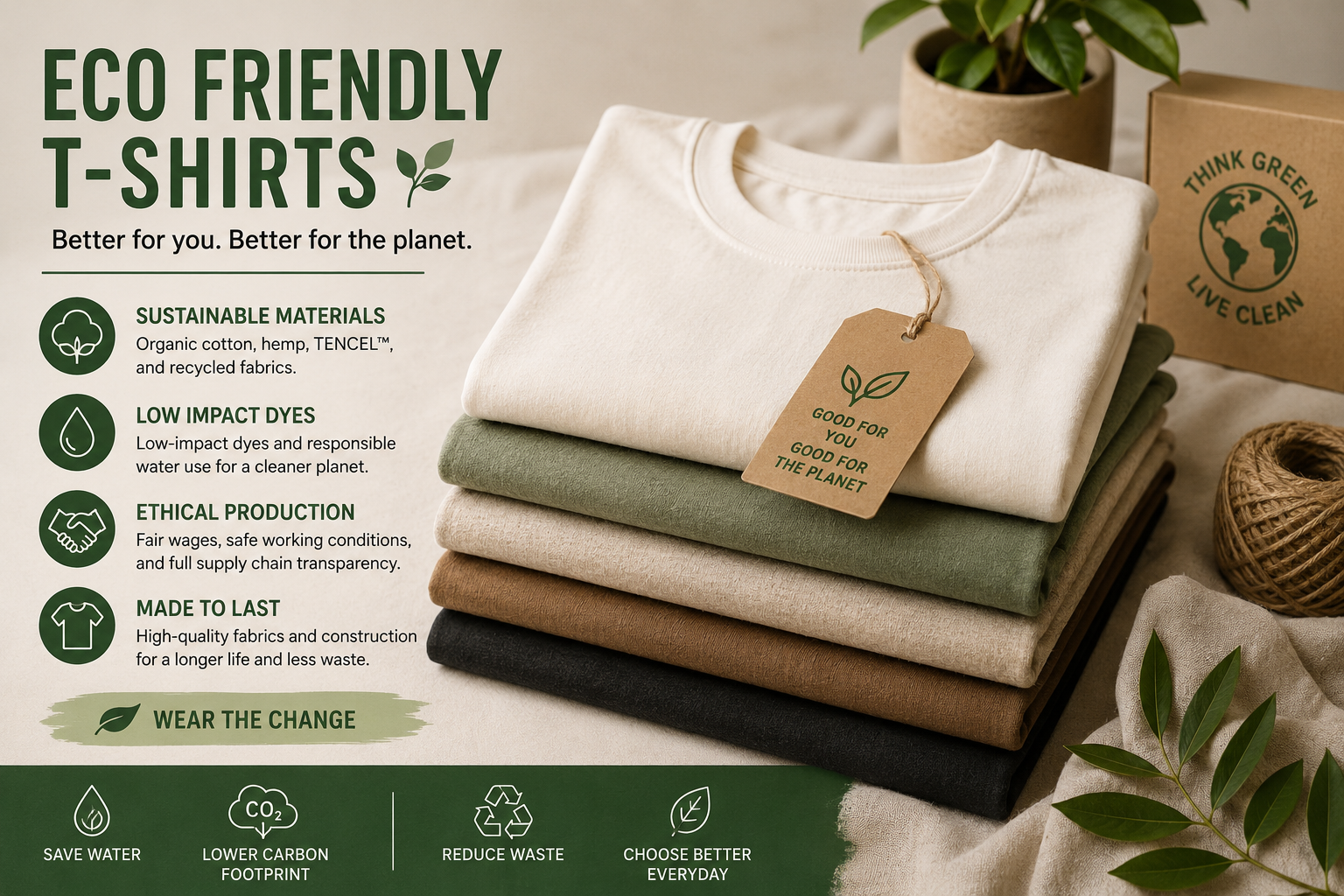
The humble t-shirt is the most democratic garment on earth. It costs a few dollars or a few hundred, it fits every body, and almost everyone owns at least a dozen. That ubiquity is exactly the problem. Roughly two billion t-shirts are sold worldwide every year, and the way most of them are grown, dyed, sewn, shipped, and eventually discarded makes the basic tee one of fashion’s quietest environmental heavyweights.
Which is why eco friendly t shirts have moved from niche curiosity to genuine consumer demand. But the label “eco-friendly” is unregulated in most markets, and a shirt can carry a green leaf logo while being made from conventional cotton in a factory that discharges untreated dye effluent into a river. If you want to buy better — or build a wardrobe that doesn’t quietly undo your other efforts — you need to know what actually separates a sustainable tee from a marketing exercise.
The Real Footprint of a Conventional T-Shirt
Start with the raw number that gets quoted most often: a single conventional cotton t-shirt consumes somewhere around 2,700 litres of water across its life cycle. That figure includes irrigation, processing, and dyeing, and while it varies enormously by region and farming method, the order of magnitude holds. It is roughly what one person drinks in two and a half years.
Cotton is also chemically intensive. The crop occupies about 2.5% of global arable land but has historically accounted for a disproportionate share of insecticide use. Add the dyeing stage — textile dyeing is among the largest industrial polluters of freshwater globally — and a garment that feels innocuous starts to look expensive in ways that never appear on the price tag.
Polyester tees present a different problem. They use less water and are often cheaper, but they are made from petroleum, they shed microplastic fibres with every wash, and they do not meaningfully biodegrade. A polyester blend tee thrown away today will still be intact long after the person who wore it is gone.
Then there is volume. The industry produces far more clothing than it sells; estimates of unsold or destroyed inventory run as high as 30% of what’s manufactured. A garment that is never worn has the worst footprint of all, because every litre and every gram of carbon was spent for nothing.
What Actually Makes a T-Shirt Eco-Friendly
Sustainability in apparel is not a single attribute. It’s a stack of decisions, and a genuinely responsible tee gets most of them right.
The fibre. Organic cotton is grown without synthetic pesticides and fertilisers, and typically uses rain-fed rather than irrigated water, cutting the water figure substantially. Hemp is better still — it grows fast, needs little water, improves soil health, and produces a fibre that softens beautifully with age. Linen, from flax, is similarly low-input. TENCEL Lyocell and Modal are semi-synthetic fibres made from wood pulp in a closed-loop process that recaptures more than 99% of the solvent used; they drape well and feel cool against the skin. Recycled cotton and recycled polyester (rPET) divert existing material from landfill, though recycled cotton has shorter fibres and is usually blended for strength.
The dye. Look for low-impact or fibre-reactive dyes, and for brands that mention water treatment or closed-loop dyeing. Undyed and naturally dyed tees are the lowest-impact option of all, which is part of why so much of the sustainable market sits in ecru, oatmeal, and soft greys.
The print. If the shirt is printed, water-based and discharge inks are far preferable to plastisol, which is PVC-based and sits on the fabric as a plastic layer. Direct-to-garment printing on demand also avoids the overproduction problem entirely, because nothing is made until someone actually wants it.
The people. Environmental and labour standards are not separable. A factory that dumps dye is rarely a factory that pays fairly. Fair Wear Foundation membership, SA8000, or transparent supplier lists are meaningful signals.
The lifespan. This is the one most shoppers underweight. A tee made from long-staple combed cotton at a heavier weight — say 180–220 gsm — with reinforced shoulder seams and a properly ribbed collar will survive years of washing without warping. A thin, loosely knit shirt will pill and lose its shape in a season. Doubling the useful life of a garment cuts its annual footprint roughly in half, which means construction quality is an environmental specification, not just a comfort one.
Certifications Worth Trusting
Because “sustainable” means nothing legally, third-party certification is your best filter:
- GOTS (Global Organic Textile Standard) — the strongest label for organic fibre content, covering both environmental and social criteria across the whole supply chain.
- OEKO-TEX Standard 100 — tests the finished product for harmful substances. It’s a chemical-safety standard, not a sustainability one, so treat it as necessary but not sufficient.
- GRS (Global Recycled Standard) — verifies recycled content and the processing chain.
- Fair Wear Foundation / Fairtrade — labour conditions and wages.
- Cradle to Cradle and B Corp — broader company or product-level assessments.
If a brand claims organic cotton but names no certifying body, treat the claim as decorative.
How to Spot Greenwashing
Vague adjectives are the tell. “Conscious,” “eco,” “responsibly made,” and “natural” carry no defined meaning. Specific claims are the opposite: “GOTS-certified organic cotton, knitted and dyed in Portugal, 210 gsm” tells you something checkable.
Watch for the single-attribute trick, where a brand loudly promotes recycled packaging while saying nothing about the garment. Watch for offsetting used as a substitute for reduction. And watch for scale mismatches — a fast-fashion label releasing an “eco” capsule of twelve items while producing thousands of new styles a week is not changing its footprint; it’s changing its advertising.
Where Quality and Sustainability Meet
There is a version of sustainable fashion that looks like sackcloth, and there’s a version that simply looks good — cut properly, in a substantial fabric, in colours you’ll still want in three years. The second version is more effective, because people actually wear it. Guilt is a poor motivator; a shirt you reach for every week is a better one.
That premium end of the market has grown quickly. Independent labels like Archibald Frederitch have built around the idea that a responsibly made basic should feel like an investment piece rather than a compromise, with their eco-luxury collection focused on elevated everyday staples rather than seasonal churn. Since sustainable tees typically carry a higher unit price than mass-market equivalents, it’s worth checking a brand’s current offers and promotions before committing to a full set — building a capsule of five or six good tees is more economical bought together than one at a time.
Run the cost-per-wear maths and the premium usually disappears. A $12 tee worn 20 times before it sags costs 60 cents a wear. A $45 tee worn 200 times costs 22 cents. The cheaper shirt is the expensive one.
Caring for Eco Friendly T Shirts
Up to two-thirds of a garment’s lifetime energy use can happen after you buy it. A few habits change that dramatically:
- Wash cold. Most laundry energy goes to heating water. 30°C or lower is enough for ordinary wear, and it protects fibre and colour.
- Wash less. T-shirts rarely need washing after one wear unless you’ve genuinely sweated through them. Airing works.
- Skip the dryer. Tumble drying is the single most destructive thing you do to a t-shirt. Line drying preserves shape, elastane, and print.
- Use a microfibre-catching bag for any synthetic or blended items.
- Turn printed tees inside out and use a gentle detergent without optical brighteners.
The End of the Line
When a tee is finally finished, don’t bin it. Undyed natural-fibre shirts compost. Worn shirts become excellent rags, cleaning cloths, or quilt backing. Many brands and retailers now run take-back schemes that feed textiles into mechanical recycling. And small repairs — a re-stitched hem, a darned underarm — extend a garment’s life at essentially zero environmental cost.